Episode 4 — Master Governance, Risk Management, and Compliance Principles for Security Programs
In this episode, we’re going to build a clear, beginner-friendly foundation for what governance, risk management, and compliance actually mean when you’re trying to run a security program that makes sense to real humans. The Certified in Governance, Risk and Compliance (C G R C) mindset is not about memorizing buzzwords, because it’s about understanding why organizations make security decisions, how they decide what matters most, and how they prove they did what they said they would do. Brand-new learners often picture security as tools and alerts, but governance and compliance live one layer above that, where decisions, priorities, and accountability get set. If you can understand these principles early, a lot of later topics stop feeling like a confusing alphabet soup of frameworks and documents. The goal is to make the concepts feel connected and practical, so when you hear terms like policy, risk appetite, control, and evidence, they land in a system instead of floating around in your head.
Before we continue, a quick note: this audio course is a companion to our course companion books. The first book is about the exam and provides detailed information on how to pass it best. The second book is a Kindle-only eBook that contains 1,000 flashcards that can be used on your mobile device or Kindle. Check them both out at Cyber Author dot me, in the Bare Metal Study Guides Series.
Governance is the part that answers who decides, based on what authority, and for what purpose. It sounds formal, but at its core, governance is simply the way an organization steers itself, like a set of rules for decision-making that keeps people aligned. In security, governance defines what security means for this organization, what outcomes matter, and what boundaries the security program must respect. It also sets the tone for integrity, because when governance is weak, security becomes a collection of personal opinions and inconsistent choices. A good way to think about governance is that it creates the why and the what, while other parts of the program handle the how. Governance also makes sure security decisions don’t exist in a vacuum, because they have to support business objectives, legal obligations, and ethical expectations. When someone asks why a security rule exists, governance is the part that should be able to answer in plain language.
A security program is basically an organized, repeatable way to manage security over time, rather than a one-time project. Beginners sometimes imagine a program as a pile of tasks, like training, patching, and monitoring, but a real program has structure, ownership, and continuous improvement built in. A program includes policies that set expectations, standards that make expectations specific, and procedures that describe how people follow those expectations in daily work. It also includes measurement, because without measurement you can’t tell whether controls are working or whether risks are changing. Governance connects all of this by defining decision rights, meaning who has the authority to approve policies, accept risks, and allocate resources. Without decision rights, people can argue forever about what should happen, and the program stalls. When governance is strong, the program becomes a stable machine that keeps running even when staff change.
Risk management is the disciplined habit of dealing with uncertainty in a way that supports the organization’s goals. Risk is not the same thing as a threat, and it is not the same thing as a vulnerability, even though those words get mixed together in casual conversation. A threat is something that could cause harm, a vulnerability is a weakness that could be exploited, and risk is the combination of how likely harm is and how bad the harm would be if it happens. Risk management takes that messy reality and turns it into decisions, like what to fix first, what to monitor, what to transfer, and what to accept. For beginners, the key is that risk management is not about eliminating all risk, because that is impossible and usually too expensive. It is about choosing the right risks to take and controlling the risks that would cause unacceptable harm.
One of the most important risk ideas in governance work is risk appetite, which is the amount of risk an organization is willing to accept in pursuit of its objectives. This is not a personal preference and it is not a guess, because it should be set intentionally by leadership and expressed in a way that guides decisions. Risk tolerance is related but more specific, describing acceptable variation within a particular area, like how much downtime is tolerable or how much data exposure is tolerable. When you understand appetite and tolerance, you can see why two organizations might make different choices while both being rational. A hospital, a bank, and a small retail shop can all care about security, but the consequences of failure and the operational constraints differ, so their decisions differ. A mature security program uses risk appetite to avoid random decision-making. Instead of arguing about what feels scary, you argue about what exceeds agreed limits, and that makes security discussions more productive.
Compliance is the part that focuses on meeting external and internal requirements and being able to demonstrate that you met them. Requirements can come from laws, regulations, contracts, industry standards, and organizational policies, and compliance work is about translating those requirements into something the organization can actually do. Beginners sometimes hear compliance and assume it means paperwork for its own sake, but the deeper purpose is trust. Compliance allows customers, regulators, and partners to have confidence that the organization follows expected rules, especially when sensitive data or critical services are involved. Another misconception is that compliance equals security, but compliance is not the same as being secure. Compliance can raise your baseline and force consistency, but a compliant organization can still have weaknesses, and an insecure organization can sometimes pass a narrow checklist. The healthier view is that compliance is one driver of security, but good security uses risk thinking to go beyond minimum requirements.
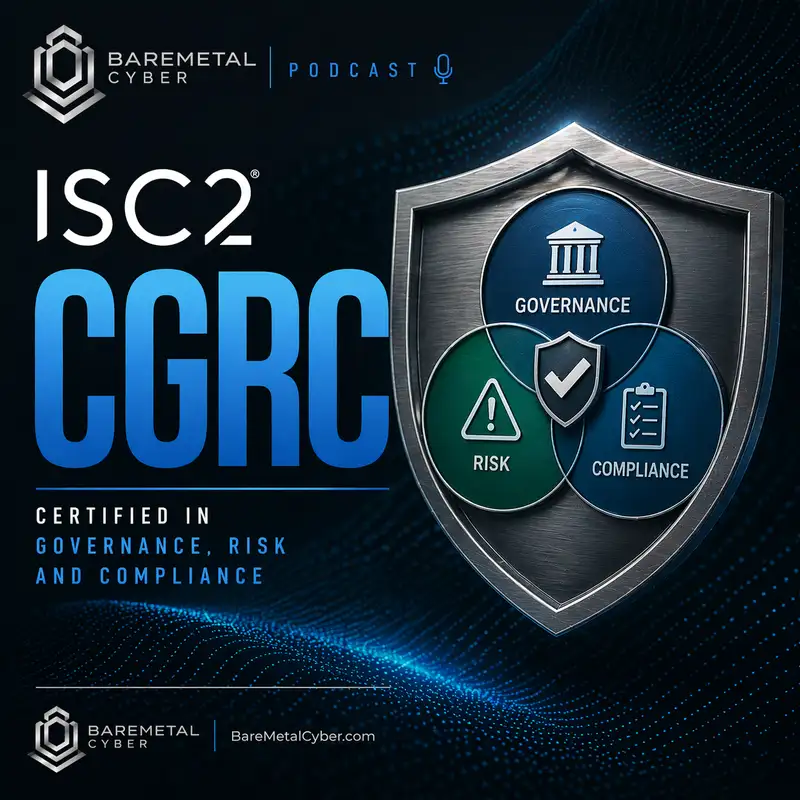
These three areas fit together like a chain of cause and effect. Governance sets direction and accountability, risk management evaluates uncertainty and prioritizes effort, and compliance ensures requirements are met and proven. If governance is missing, risk management becomes inconsistent because nobody agrees on priorities or decision rights. If risk management is missing, governance becomes disconnected from reality because it can’t respond to changing threats, technologies, and business needs. If compliance is missing, an organization may violate obligations without realizing it, and it may be unable to prove good behavior even when it is doing the right things. A strong security program treats all three as part of a single operating system. You can think of governance as the steering wheel, risk management as the road awareness, and compliance as the rules of the road and the proof that you followed them. None of those pieces alone gets you safely to your destination.
A key idea that connects governance to daily security work is policy, because policy is where leadership intent becomes an expectation for everyone else. Policies should be written in a way that people can understand and follow, but they also need to be enforceable, which means they must be specific enough to guide decisions. Good policies define scope, meaning what systems, data, or activities they apply to, because vague scope creates hidden gaps. Policies also define responsibilities, meaning who must do what and who must approve exceptions, because lack of ownership is one of the most common causes of failure. In a program, policies are not meant to sit on a shelf; they are meant to drive behavior and decisions. A beginner-friendly way to spot weak governance is to look for policies that no one can explain, no one follows, or no one feels responsible for maintaining. When policies become living documents tied to real work, governance starts to become real.
Controls are the mechanisms that turn requirements and risk decisions into actual protections and behaviors. Controls can be administrative, like policies and training, technical, like system safeguards, and physical, like access restrictions to spaces and equipment. The main point for beginners is that controls are not random security tricks; they are chosen because they address specific risks or specific requirements. A strong security program maps controls to reasons, meaning you can explain why each control exists and what it is supposed to reduce or prevent. This is where governance and risk management show up in practical form, because your control choices reflect your priorities and your willingness to accept certain risks. Controls also need to be realistic, because a control that looks great on paper but cannot be followed in real life becomes a compliance problem and a security problem. The best control is one that people can actually perform consistently without breaking business operations.
Evidence is what transforms a security program from good intentions into demonstrable reality. In governance and compliance work, it’s not enough to claim you have a policy or claim you follow a process; you have to be able to show it in a reliable way. Evidence can take many forms, like records of reviews, approvals, training completion, monitoring results, and documented exceptions. The danger for beginners is assuming evidence is just screenshots and files, when the deeper idea is traceability. Traceability means you can follow the trail from a requirement to a control to proof that the control was implemented and is functioning. This trail matters because audits, assessments, and incident reviews often ask not only what you did, but how you know it worked and who approved it. A mature program designs evidence collection into the process, so people are not scrambling at the last minute. When evidence becomes routine, compliance becomes less stressful and security becomes more measurable.
Another principle beginners need early is the difference between managing risk and managing fear. Fear tends to focus on dramatic events and worst-case stories, while risk management focuses on likelihood, impact, and practical decisions. This difference matters on exam questions and in real governance work because the best answer is often the one that is calm, proportional, and aligned with organizational goals. If a scenario describes a moderate risk with clear compensating controls, an extreme response can be overreach and waste. If a scenario describes a high-impact risk to critical data, an underreaction can show poor judgment. Learning to calibrate response is a core skill in C G R C thinking. Calibration depends on context, like what assets are involved, what the business depends on, and what obligations apply. Over time, you start to see security as a portfolio of decisions rather than a single battle against every possible threat.
A security program also relies on clear roles and accountability, because governance without ownership is just decoration. When responsibilities are unclear, tasks fall through gaps, controls drift, and exceptions become informal habits that nobody tracks. Good programs assign owners for policies, owners for systems, owners for risks, and owners for compliance activities, with clear authority to make decisions. This does not mean one person does everything; it means someone is responsible for ensuring the work happens and for coordinating across teams. Beginners often underestimate how much security success depends on coordination rather than technical brilliance. Governance establishes who has the power to approve, who must be consulted, and who must be informed, and those patterns reduce conflict. A mature program also defines how disputes are resolved, because risk decisions sometimes involve tradeoffs between speed, cost, and safety. When roles are clear, those tradeoffs become structured discussions rather than chaos.
Finally, it helps to understand that governance, risk management, and compliance are not separate boxes you visit once a year, but continuous cycles. Governance regularly revisits objectives, priorities, and policies as the business changes. Risk management continuously assesses new systems, new threats, and new weaknesses, and it updates priorities as reality shifts. Compliance continuously checks whether obligations are being met, whether evidence is complete, and whether controls are operating as intended. This cycle is what prevents a program from becoming stale, because stale programs are the ones that look fine on paper but fail during real incidents or audits. For beginners, the most useful mindset is to think of the program as a living system that must be maintained like any other system. If you stop maintaining it, it degrades, even if you did great work at the start. The C G R C perspective is about keeping that system healthy through clear intent, disciplined decisions, and demonstrable proof.
As we close, the core principles you should carry forward are straightforward, even if the field sometimes tries to make them sound complicated. Governance gives you direction, decision rights, and accountability, so security work aligns with organizational objectives and integrity instead of personal opinion. Risk management gives you a rational method for prioritizing effort under uncertainty, so you spend limited resources where they matter most. Compliance gives you the discipline of meeting requirements and producing evidence, so trust is earned and verified rather than assumed. When these three work together, a security program becomes coherent: policies guide behavior, controls reduce risk, and evidence proves outcomes. When they don’t work together, security becomes reactive and inconsistent, and audits become stressful surprises. If you keep these relationships clear in your mind, the rest of the C G R C material becomes easier, because every framework, document, and requirement will feel like it has a place in the overall system.